
What Does a Client Consultant Do for IT?
Every managed IT client at Think gets a client consultant: a fractional CIO who runs quarterly planning, keeps a three-year budget, and handles your cyber insurance paperwork.
In this article
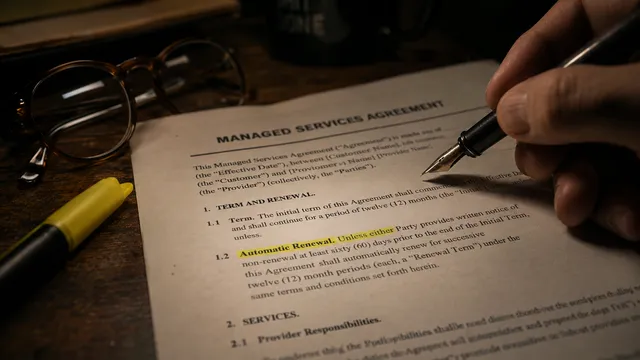
Your cyber insurance renewal lands in the office manager’s inbox on a Tuesday morning. Seventy-four questions. The carrier wants screenshots, attestations, and proof that multi-factor authentication covers every account, that backups are tested nightly, and that you have a documented incident response plan. Your office manager has twenty minutes between meetings and no idea what half the questions mean.
This is what a client consultant is for.
Most managed IT providers do not work this way. They have an account manager: someone who shows up a few times a year, asks if everything is going well, and leaves. Some call that person a Virtual CIO. Some call them a client success manager. At Think, we call them client consultants, and the role does more than a quarterly handshake. Here is what it actually covers.
Your Advocate Inside Our Company
The first job of a client consultant is to represent you internally.
When you submit a ticket, dispatch triages it. When a project gets scoped, professional services prices it. When a security alert fires, our SOC investigates it. A lot of teams touch your environment. None of them know your business the way your client consultant does.
Your client consultant makes sure our teams know your priorities and constraints. If a ticket is heading somewhere that does not match your expectations, they redirect it. If a project estimate comes in high, they make sure it reflects what you actually need, not the most expensive version of it.
This work happens in Slack threads and standups, not in your inbox. You rarely see it. It is also the reason things move.
Strategic Planning Sessions
Every managed client gets a quarterly strategic planning session.
Most MSPs call these Quarterly Business Reviews. We renamed them because what happens in the meeting is closer to strategic planning than to reviewing last quarter’s ticket volume.
A strategic planning session is a conversation with your leadership team. Not a slide presentation. A conversation. We want to understand:
- How you produce revenue
- What makes you different from your competitors
- Why your customers choose you
- What the next twelve, twenty-four, and thirty-six months look like
- Whether you are expanding, opening new locations, hiring, contracting, or being acquired
- Whether a new line-of-business application is coming, and when
None of that is about technology directly — it is about making sure the technical decisions match where the business is going. Planning a network migration gets easier when we already know a second location opens in the fall. Budgeting for a firewall refresh gets easier when we already know you are adding fifteen employees next year.
Your client consultant runs these sessions with a member of Think’s leadership team. Leaders talking to leaders. That is a deliberate choice. Your CEO should not be briefing a field technician on a three-year revenue plan.
The Three-Year Technology Budget
Every managed client has a rolling three-year technology budget. Your client consultant keeps it current.
The budget tracks when hardware reaches end of life, when software loses vendor support, when licensing structures change, and what each item costs. By the time something hits the plan, you already knew it was coming and what it cost.
This matters because IT projects get expensive mostly when they are reactive. Windows Server 2016 reaches end of support in January 2027. Our clients have known since 2023. We have budgeted and scheduled every migration. Most wrap up by June. Not because we are smarter than other providers. Because we keep a real plan.
Most business owners have never seen a three-year IT budget, because most providers do not maintain one. If you ask your current provider what you will spend on technology in 2028 and the answer is hand-wavy, that tells you something.
Compliance, Insurance, and Vendor Questionnaires
Every year, your cyber insurance carrier sends a renewal application. Your payment processor sends a PCI questionnaire. Your enterprise customers send vendor risk assessments. New prospects send security questionnaires before they will sign a contract.
These documents mix business questions with technical ones. The business side (revenue, claims history, financial controls, internal procedures) stays with your team. We handle the technical side. Is MFA enforced on every account? What is your backup frequency and retention policy? Have you tested a disaster recovery restoration in the last twelve months? What endpoint detection and response platform do you use? Where is your data stored, and is it encrypted at rest?
Your client consultant answers those. They gather the evidence, pull the screenshots, and fill in the technical sections. Because we actually deploy the systems these documents ask about, the answers are real and we can prove them. This is one of the less glamorous parts of managed IT. It is also one of the most valuable when an insurance renewal lands or a major customer asks for proof.
Vendors and RFPs
Your client consultant works with your other technology vendors: your line-of-business software provider, your phone carrier, your printer company, your cabling vendor. When something breaks across the boundary between our environment and theirs, your client consultant coordinates the fix.
When you evaluate new software, we run the process with you. Writing the RFP. Scoring vendors on technical fit. Reviewing contracts for the security language that matters. Sitting in on demos where the vendor will try to handwave the parts you should pay attention to. We have been through hundreds of these. You have not. That asymmetry costs money when you face it alone.
Hiring Help for Co-Managed Clients
Some of our clients keep internal IT staff and want us working alongside them rather than replacing them, an arrangement we break down in how co-managed IT actually works. For these Co-Managed clients, your client consultant helps with hiring.
That has looked like: writing the job description, reviewing resumes, interviewing candidates, designing the first thirty-day onboarding plan, and setting continuing education requirements. Hiring an IT person is hard when you do not know what good looks like and the candidate knows it. We know what good looks like.
This is not a standalone recruiting service. It is part of the relationship with Co-Managed clients who want a partner in the decision, not another pair of hands on tickets.
The Cadence Tracks What Is Happening
When we bring on a new client, your client consultant meets with you every week for the first couple of months. Too much is changing too fast to stretch the gaps longer than that.
Once things stabilize, cadence moves to every two weeks, then to monthly. Monthly is the steady state. You have a standing touchpoint, we review open tickets and active projects, we talk through anything coming up, and we move on.
Then something changes. You sign a lease on a second office. You acquire a smaller competitor. You are rolling out a new ERP. The cadence snaps back to weekly until the project closes, then returns to monthly.
The point: you do not disappear from our radar when things are quiet. The relationship does not depend on you raising your hand.
A Partnership, Not a Vendor Contract
A good managed IT relationship should feel like having a fractional CIO on the team. If it feels like a vendor contract, something is missing.
You should not have to explain your business to your IT provider every time something comes up. You should not have to guess what a three-year technology plan ought to look like. You should not be the one reading cyber insurance questionnaires on a Tuesday morning.
The client consultant role is the part of managed IT that makes the rest of it work. Help desk, security operations, backups, projects. All of it sits on top of a relationship that only exists because somebody is keeping it alive.
If you are evaluating managed IT and want to see what this looks like in practice, start a conversation. We will show you a real three-year technology budget, walk you through what a strategic planning session actually covers, and answer any questions about how the client consultant role works day-to-day.